My guide to super-gluing boots, soiling oneself, and finding villages in the dark (Part 1)
“Do you get scared when travelling alone?”
“Not really” I lie. “Why’s that?”
“Whenever I sleep alone at Uncle’s hostel in Pokhara, I close all the doors and windows because I see ghosts”
“Yeah sometimes our eyes can play tricks on us” I offer.
“Do you know about when ghosts go into people’s hearts?” The boy silently mimes a seizure in the dimly lit room and I stare, weighing him up.
There was no compromise in his gaze. The kid was at that awkward age, when it came to such a topic. Old enough not to be able to just pass him to Auntie, but young enough still to reveal his innermost beliefs without pretense.
“A Lama has to come” he continues easily, “and he speaks the words to make the ghost go. Who does it in your country?”
“Well a-uh priest, I guess. A Catholic priest”
The boy nods gravely like it’s all self-evident. ‘I have seen this thing with my eyes when a ghost comes into my mother’ He rolls his eyes back in his head again and this time I look away slightly. ‘Catholic, Buddhist, Hindu. It’s all the same thing and I believe they are real’.
“Wow, okay” I offer into the silence and the conviction in his eyes assures me there’s nothing more I need add.
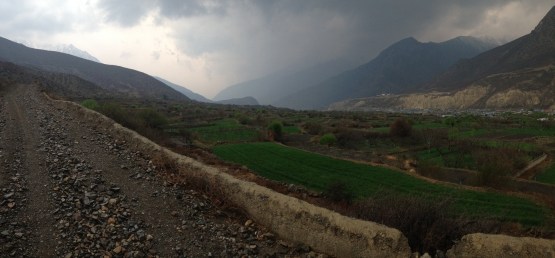
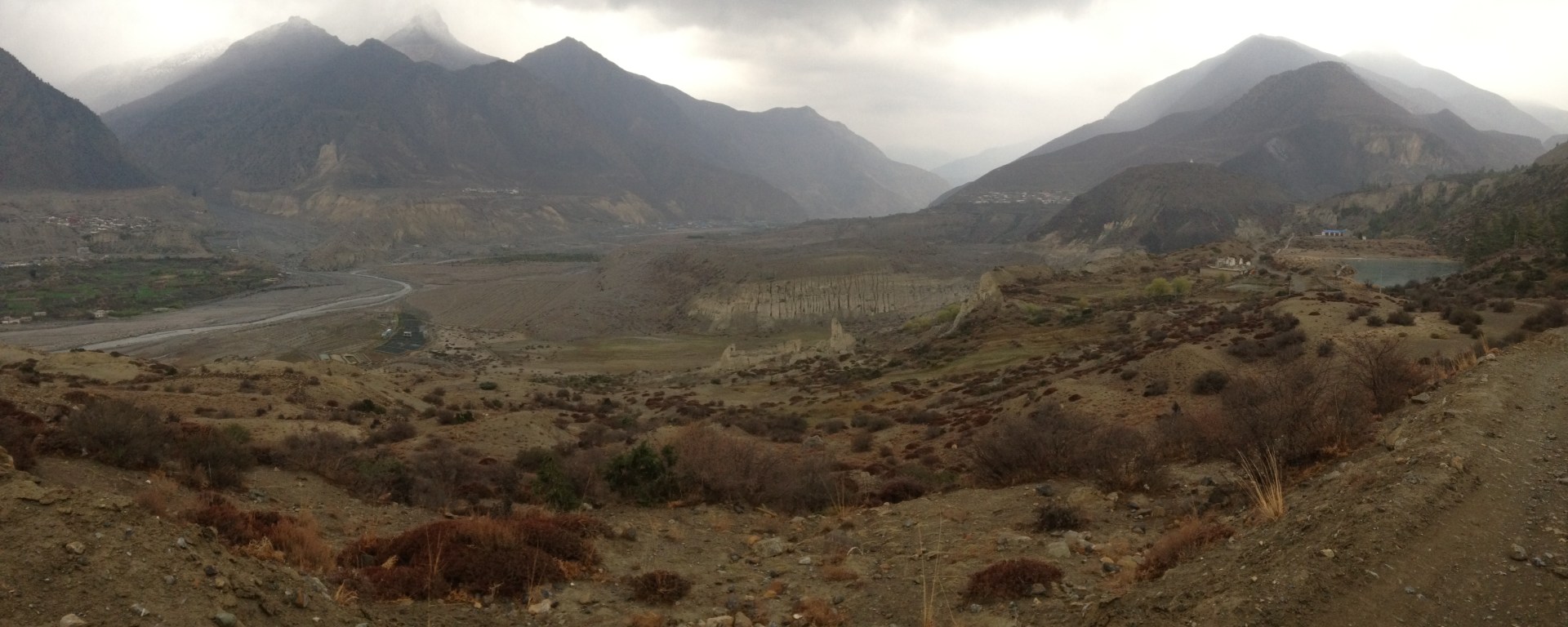
The hills echoed with the booming of thunder as I wound up the path out of Jomsom. Two students had walked with me to the outskirts where I’d joked about the ideal trekking weather. The boys had laughed politely before hurrying indoors. I scanned the burgeoning clouds. Although only about 1pm, the day seemed to have peaked hours before. The rain would come. Between the peals of thunder though, the Kali Gandaki Valley was quite silent, a theme for this side of the Annapurna Circuit. Sure, the earthquake still had people reluctant to return to Nepal but the solitude I felt most days had definitely exceeded expectations.
Which really made days like today more of an adventure.
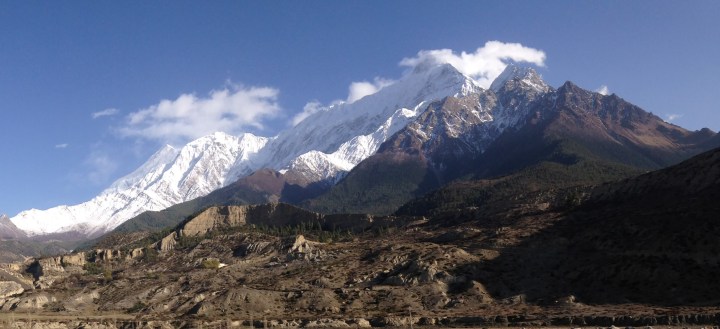
Indeed, I experienced some amazing things that afternoon, but none of it felt extraordinary in Nepal. The kids running out for sweets and default classroom English, farm animals doing bizarre things (a lone white cow stared incredulously as I snapped a photo of it atop a deserted set of steps) and walking through landscapes that would slam against my senses and dare me to imagine something – anything – bigger or more ruggedly beautiful.
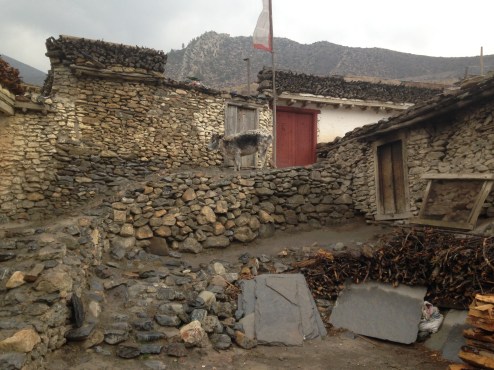
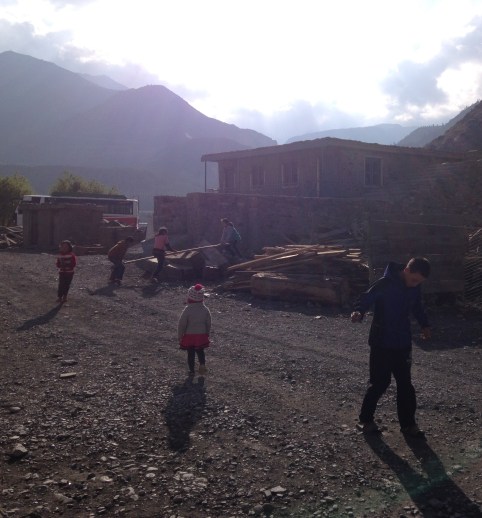
The fun really began to start when I pulled into Dhumbar, a tiny village down the side of a stark cliff I’d just descended, crowned with the token monastery and prayer flags. The sun had been and gone in this nook of the valley but I stopped to fill my bottle anyway, a little more worn out and a little later in the day than I wanted to be. I was looking for a town of apple orchards called Marpha but I never found it. As I popped a chlorine tab in my water, my gaze was caught by a group of kids messing round nearby. They were playing hackey with what looked like a homemade bunch of springs bundled together.
‘Oh man’, I thought – ‘I’ve found my people’.
I wandered slyly over, stuffing the hackey sack I’d bought in Kathmandu into my back pocket as I went. The kids eyed me as the bearded, bucket-hatted gringo came on, their expressions flashing between deep curiosity and polite indifference. I gave the little monkey who was watching them a ‘sup’ and he smiled toothily at me. I showed him the hackey and the spell broke. The others converged on us and I stood and lobbed it to one of the older girls who seemed to own the Nepali style hackey. It hit her in the shoulder and promptly dropped to the ground. She giggled, embarrassed, abruptly picking it up and smiling round bashfully. I gestured for her to pass it and I scored some points with a little showing off.
Shit kicked off after that.
Half an hour later I lent back on the wall and let the munchkins go at it, noticing for the first time that the sun had set. I asked where Marpha was. An older lad pointed in a direction that completely contradicted what my map said. My heart sank.
“By the new trail aye. So two or three hours then?”
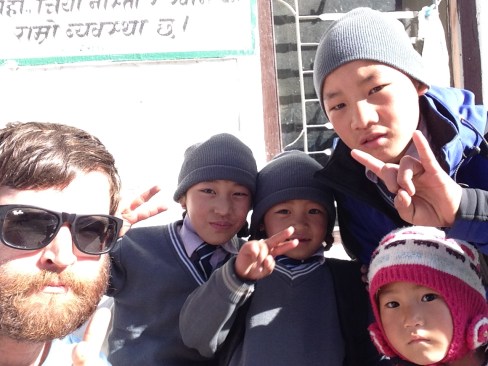
The boy nodded earnestly and pointed again for emphasis. I’d based my walking time from the Lonely Planet but taken my directions from the map which I found later to be about 2 years apart in relevance. Nodding briskly, I asked for a farewell selfie and we said our goodbyes. Knowing I’d cause a scrap if I just handed over the hackey, I gestured to an older woman on the way out and when she smiled yes, I tossed it to her instead.
Scrambling out onto a gigantic riverbed below, a farmer interrupted my course confirming my hunch that I’d never make it to Marpha now and that I should try find a village back in the main valley. I thanked him and, breaking into a trot, stumbled back the way I came in the gathering dusk, the scraping of the stones the only noise now to be heard in the watchful hills.
It’s funny how quickly a gratifying day can turn into self-contempt when you’re travelling alone.
“You idiot” I grumbled as I hurried off the stones and into a thick patch of woods above the riverbed. “This is how solo trekkers get attacked you moron”. “But no, you had to play friendly gringo with a bunch of kids instead of finding a bed”. I began to notice the odd ruined building, barely visible among the trees. My eyes strained for a sign of life, a fire, someone moving about, but there was nothing. There was nothing ahead either. Old gates swung open and shut with no one to push them. Half-imagined possibilities swam through my head; A desperate group of Nepali youths; A Snow Leopard. I reluctantly remembered the backpacker whose decapitated body had been found in the Langtang Valley only a couple of years before.
I tried to keep my eyes and mind on the trail.
A volley of vicious barks erupted to my left. The squirming anxiety I thought I’d left behind at the start of the circuit came whooshing back in a wave of dread. I quickened my pace, not risking my balance to see if the dogs were giving chase – not that I would see them coming anyway. With no help from the new moon, dark had fallen in earnest.

When I was sure I wasn’t being followed I slowed to get my bearings. High above, the silhouette of the monastery I’d passed that afternoon stood foreboding against the deep blue. Indifferent to my worry, it oversaw my descent down out of trees and onto the open dirt trail. I had my headlight out but hesitated to use it, for fear of attracting the attention of opportunists, human or otherwise. I pressed on. Within half an hour a bridge materialized a little way ahead. Scanning with my light I spotted the name ‘wooden bridge’ on a sign that the farmer had told me to look out for. In ordinary circumstances I would have tried for something witty to say about Nepali creativity but I was so pleased that I crossed its creaky heights without a single sarcastic thought.
I was focused alright.
Seeing candlelit movement in a house ahead I called out a shaky “Namaste” that I’d hoped to sound more at ease. There was a great deal of scuffling. Seconds later I was blinded by a torch to the eyes and a bemused family of seven crammed themselves into the doorway – they looking on intently and me trying to look at anything at all. I explained my predicament and quickly got to the guts of it. “Hotel?” “It’s close?” The mother pointed right along the trail and after I managed to falter with her simple instructions, did better on it, and sent her noticeably-ballsier-than-me five year old son to accompany me.
We walked together into another house.
And into a party in full swing. A room full of mostly older Nepali men swung round to look at me, glasses of Raksi raised halfway to their open mouths. Rather rudely too, I thought. Apparently no one in the village’s premium house party had expected a white guy to crash the place at 10, demanding dinner and a duvet.
I mean, shit was just presumptuous.
My young friend exchanged a rapid fire Q&A with the head of the house. The older gentleman looked intently at me, nodding for a little while. I did my best ‘ocean of patience’ impression.
His daughter interrupted us. “They not speak English. There’s no dinner. I mean, what’s for dinner?”
She took a steadying breath.
“What you like?”
“Oh I um yes please. I mean, what’s there?”
Her brother, a smiling, shaven-headed youth of 14 stepped out of the onlookers. “We have a room for you, but there’s only Dal Baht. It’s okay?”
“Oh wow yeah cheers” I mumbled gratefully as he and his dad led me through the now subdued room where the guests were clearly struggling with whether to keep spectating or resume the festivities. “I got lost” I offered to a guest at random. He laughed and warmly parroted key words back at me.
I stepped over the threshold.
We were in an unlit r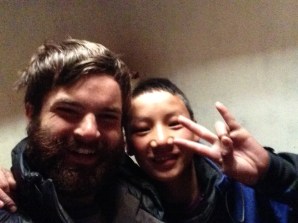 oom with cans of chemicals against its concrete walls. Strips of ginger were hanging to dry from the ceiling in a way I’d seen done before. Quite unfortunately, they never failed to give me the impression of dangling entrails. Suddenly I was sure this would be my room and the dangling ginger would serve as my mobile for me to kick as I drifted off like the big lost baby I was. Thankfully we passed on to a small, well swept room with two styrofoam beds and a pile of blankets a mile high.
I’d sleep.
After assuring me I’d get the ‘Nepali price’, the father took his leave and it was just the son and I left in the cold little room. He showed me the blankets and explained about how they reserved this room for guests only. I began to note his exceptional English and confidence.
I thanked him.
“Do you…” He hesitated, clearly with some pressing question in store. “Do you get scared when travelling alone?”
“Not really” I lied. “Why’s that?”
“Whenever I sleep alone at Aunty’s hostel in Pokhara, I close all the doors and windows because I see Ghosts”
“Yeah sometimes our eyes can play tricks on us” I offered, lamely.
“Do you know about when ghosts go into people’s hearts?” The boy silently mimed a seizure in the dimly lit room and I stared, weighing him up.
There was no compromise in his gaze. The kid was at that awkward age when it came to such a topic. Old enough for you not to be able to pass him to auntie, but young enough still to reveal his innermost beliefs without pretense.
“A Lama has to come” he continued easily, “and he speaks the words to make the ghost go. Who does it in your country?”
“Well a-uh priest, I guess. A Catholic priest”
The boy nodded gravely like it was all self-evident. ‘I have seen this thing with my eyes when a ghost comes into my mother’ He rolled his eyes back in his head again and this time I looked away slightly. ‘Catholic, Buddhist, Hindu. It’s all the same thing and I believe they are real’.
“Wow, okay” I offered into the silence and the conviction in his eyes assured me I didn’t need to add anything else.
“I love talking to foreign men and ladies!” he exclaimed, suddenly brightening. He explained to me how he learnt most of his English working in a hostel in Pokhara where he made American friends who he’d promised to go and see when (or if) he got the money.
“How much was your sleeping bag liner?”
“Your Kindle?”
“How much do you get paid as a teacher?”
My defensive instincts flared up from a month spent dealing with children asking for money in India, but Dawa was just interested. I told him.
“If I pass my tests, I will become a social worker to help my country because I will remember how to feel hungry and I won’t become bad when I’m rich and educated.”
I spotted his liberal agenda a mile off and just like that I felt as if I were talking to a younger brother.
“There are some people like that in Nepal through right?”
“Yes, sir. Never give money to charities or government sir because sometimes they say they give and sometimes they do but sometimes they keep. It is better give to families directly sir”.
“Politicians take the money too?”
“Yes sir, the world-I mean Americans, and New Zealands and England people give lots of money sir but the people don’t get a lot.
That is how we stay poor – why my parents live here and why I must stay here unless I get into university”.
We spoke for hours – interrupted only briefly when his mother brought us dinner: His take on Climate Change versus his parents misunderstanding of it. Economic inequality. You name it. The strange thought that I was speaking to an intellect in a boy’s body would occasionally occur to me. Whatever I contributed he would lap up eagerly and without pre-judgement.

He coughed regularly between enthusiastic bursts of sentences and as the evening wore on, his voice started to go. It was then he showed me the big lump behind his ear, telling me his dad had said it was probably Tuberculosis. I felt a dull aching in my stomach and I was torn between offering my travel allowance as medical cover and kicking the sputtering petri dish out of my tiny room. But seeing in his face what my company meant to him, I resigned to just keep chatting with him, which was hardly selfless. He was the most interesting Nepali I’d met to date.
Once or twice when I suggested we go out into the living room, he’d pale and decline my offer with obvious distress. He didn’t like speaking English in front of Nepalis. In the village, he’d actually earnt a nickname which he told me directly translated as “Foreigners only pretend to understand you”.
It was an attitude toward English I’d come across before in Korea (and now as I write this, Argentina). There’s a certain reluctance among the older generation to embrace the foreign influence, which is fair. But it’s still hard not to have anything but contempt for someone who shames a bilingual kid. In my experience, it’s not about national pride for them, but a kind of monkey-minded jealousy.
 I communicated this to Dawa, dimly noting the slight shake my voice. I think he did too because he brightened again. Throughout the evening though, he’d self-deprecate as a matter of course. He’d also be quick to draw negative contrasts between Nepal and the West. I’d have to remind him it was education, not intelligence that separated the two. Or emphasize that Nepalis are built shorter and stronger because they’re the best climbers, not because there’s anything desirable about being tall and white. I guess if I were a kid living in the foothills of Nepal with access only to films glorifying white consumers, I’d have some pretty fucked up ideas about racial parity too.
Dawa, of course, graciously accepted my points.
We sat out in the sunshine the next morning, drinking tea with the family to wash down the breakfast of Tibetan bread Dawa’s mother had prepared. Looking out at the kids on a plank of wood they’d converted into a see saw, I fell in love with the little village. The home-stay was like a revolving door for farmers, schoolkids and parents alike. What felt like half a hundred people stopped in that morning alone – if nothing else but to just spin a yarn.
I decided to stay another night. Part of it was to do with the charm of the village (an older gentleman who appeared not to have eased up on the Raksis since the night before stumbled to and fro with his arm around my shoulders, swearing his repentance while tactfully avoiding the looks of cold murder his wife was flashing his way) and part of it was the weather (it finally broke that day). But the real reason was that I’d made my first proper friend in Dawa.
I helped him out with his Sh akespeare homework that night after school. And by help I mean I read out information from Wikipedia for him to copy down. He explained that his teacher understood when it wasn’t the student’s work if the family didn’t have the means. I noticed that half of the English conversations in his textbook were based off conversations between lost trekkers and Nepali children helping them out. I couldn’t help but admire both the irony and the Nepali government’s commitment to tourism. Dawa found no fault in it.
When I left the next day, I bought him and his sisters some treats from the family store and left the mum some extra cash. Which sounds generous, but if you’ve been to a place like Nepal, you’ll know how it is. The tiny woman thanked me to the point of embarrassment and forced another Chai on me. Again as always though, I walked away feeling as though I couldn’t put a price on the experience. Cliché – but with good reason.
As I wove goodbye to the kids and set back out on the trail, I decided going to Marpha didn’t have quite the same appeal as it had done a couple days before. I decided instead to walk as far as I could.
Being a tad lost never hurt anyone.
 jared lanigan