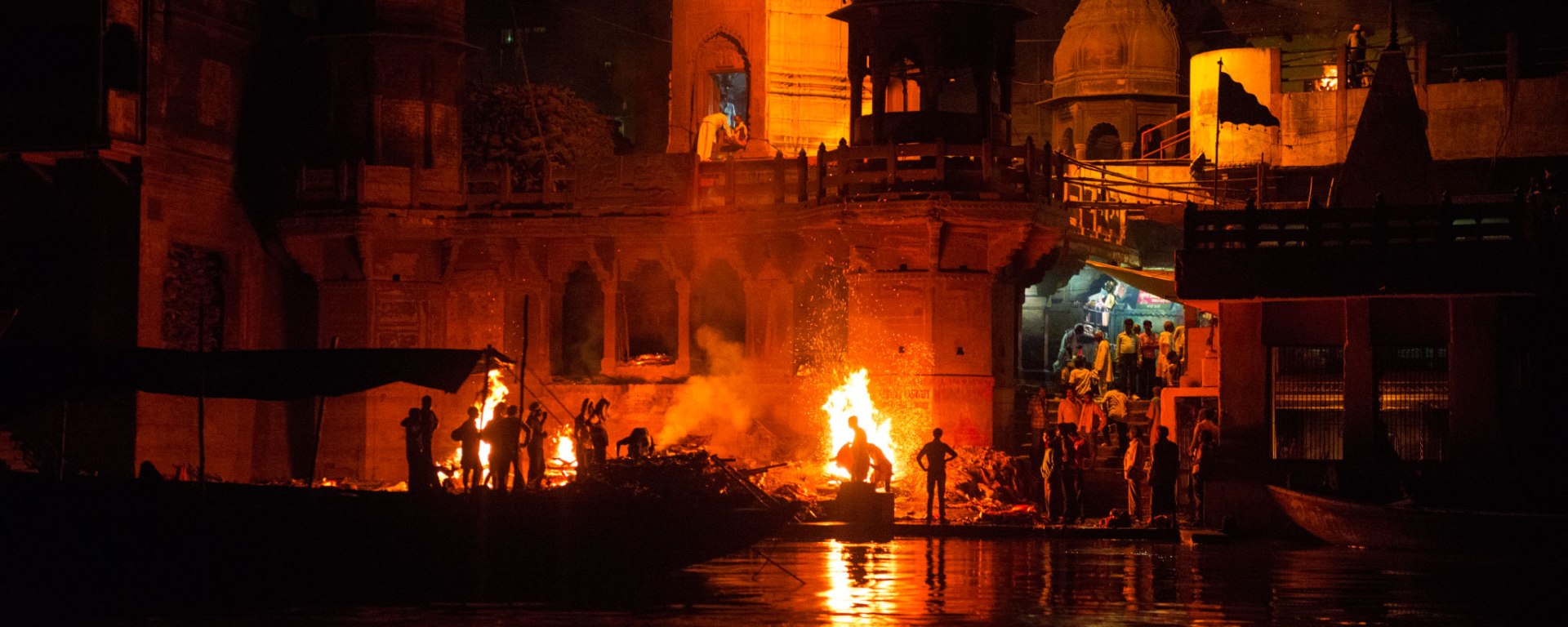
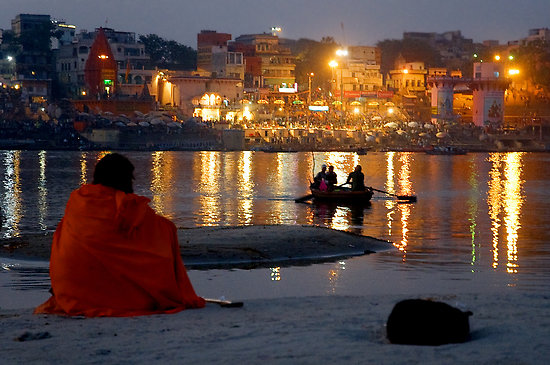
I excused myself from the Sadhu’s tent and walked out into the starry night. As I left, the entrance flaps flew in a fresh gust of wind and I shuddered. Not from the cold. But with a vague sensation of being in a storybook scene. I relieved myself, gazing across the River Ganges at the blazing inferno that was the burning Ghat. Bodies of the faithful were being brought down onto the funeral pyres in ceremonial garb. The primordial drive of the bells sounded clearly across the water, accompanied by the chanting and acapella singing of hymns; welcoming the departed souls into Moshka. I plonked down on the sand with my whisky and closed my eyes, letting out a long breath as I did. I continued to see the giant, ceremonial fire (from which all pyres were lit) impressed on the backs of my eyes, silhouetted as it was against the fortress-like Ghat.
Where it had burned continually for two and a half thousand years.
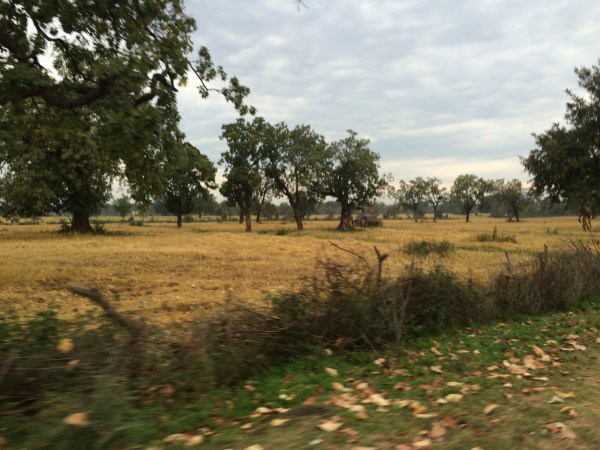
I was on the back of an old motorbike with my hotel receptionist, puttering out of Khajuraho, more commonly known by travelers as ‘The Kamasutra Temples’. A scattering of relics from the 10th century, these Sikh temples are adorned with creative carvings of miniature people, animals and Gods going at it in weird and wonderful ways. I’d been pondering how successfully modern religion had restricted that kind of expression while I half-listened to my driver speaking over the popping of the engine. ‘My friend’ was currently explaining how I had the good fortune to be on the back of his endangered carcass of a bike and in such revered company.
“I am to take you to the station myself sir because your are so kind and great and you know what else sir?”
“What?” I mused watching a Taxi pull around us and accelerate into the distance.
“Actually, Guest is God sir”
“Guest pays tips” I said to myself
My driver looked around to clarify what I’d said and I gave him a reassuring smile “Thank you for that man”
Satisfied, he turned back around, his oversized helmet nearly falling off his head as he did. Righting it, he resumed his general praise of me and I tuned out again.

In truth, I had no reason to spite this friendly chap from the Forrest Green Hotel. But my first few weeks in India had been marred by an experience in Delhi where I’d been conned by a seemingly linked series of taxi drivers, hostel owners and businessmen into paying two and a half grand for a tour I could’ve organized myself at half the price. Having flown into India off the back of a sleepless final weekend in Korea, I’d been easy pickings for the well-rehearsed ‘Tourism offices’ of Delhi. To be fair, I’d gotten my own private driver for 10 days, but all the tip-hungry old man really gave me was a guilt complex and a wicked flu that knocked me on my ass for the first 2 or 3 days. Everything travelers will tell you about tourism’s dysfunctional effect on the psyche of India has a bit of fundamental truth to it. Some people are naturally desperate there and the less moral among them will actively pull on your heart strings and lack of preparation in elaborate attempts to squeeze the pennies from you.
In fact, each hotel manager I’d met, when I’d pulled into town had first; looked forlornly at the tourism company’s name inscribed on the voucher I’d given them, second; proceeded to give me dingier rooms than I would’ve found in hostels, and finally; gone out of their way to find other means of charging me through overpriced food or transport, all of which I’d been assured would be included. All the same, these men were far cries from the deviousness of the businessmen in Delhi who’d conned me in the first place. And the man on the bike in front of me was no different. A good guy forced to react to the scams of the Capital and trying to get a share of the pie for himself and his family. Unfortunately for him and many deserving others in rural India, my heart had been successfully hardened. As we pulled into our destination I gave him the minimum respectable tip, and he didn’t quite manage to hide his hurt.
“Thank you sir, and the money is not important because Guest is God, actually”.
He then even helped me to my bus stop before leaving me alone in a town so authentically Indian, I felt for the first time in 2 weeks like a true outsider. I asked someone about the bus timetable and in no time at all was mobbed by a group of curious kids and friendly adults alike. As I threw my bag up on the roof of the bus, my new friends clambered to help and practice textbook English with me. Perhaps to offset my guilt I handed the chips packets I’d just bought for lunch to the boys sprinting and shouting alongside the bus as we took off. And regretted it.
There you are buddy. No food for a marathon bus ride ahead but at least a village will eat Doritos in your honor tonight.
Through the throng of crowded bodies I spotted a backpacker at the front of the bus and resolved to talk to her when I got a chance. My plan was foiled however when a tiny Indian man flatly insisted that I take his seat. No sooner had I sat down than I was passed someone’s child who spared no time in falling asleep and drooling over my shirt as the bus lurched and rolled over potholes in the road. The tyke was too cute for me to mind though and after an hour or so of happy chatting and bouncing out of our seats together, I asked the man next to me how old his son was. He laughed and shrugged as he pointed to a group of ladies at the front of the bus too immersed in their gossip to have noticed their white man turned babysitter.
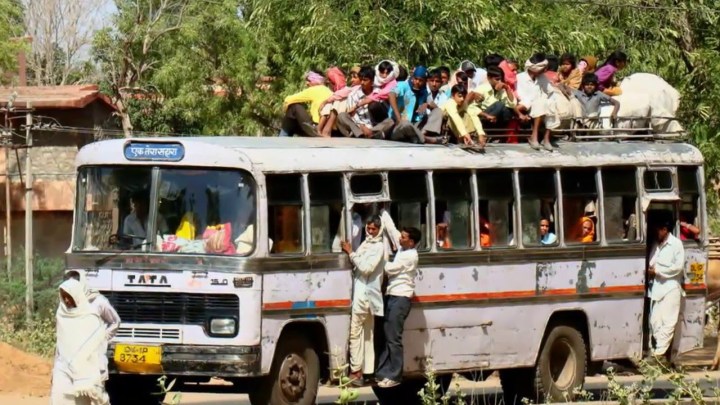
We were headed for the holy city of Varanasi in India’s North East and it turned out to be the singular experience of my time on the subcontinent.
With it’s cornucopia of fortresses, mosques and temples, Varanasi looks straight out of an Indiana Jones flick and is widely considered to be one of the most important Hindu sites. Hundreds of the sick and dying pour into the city every day to wash, pray – and when their time comes – be cremated at one of the burning Ghats that border the great river Ganges.
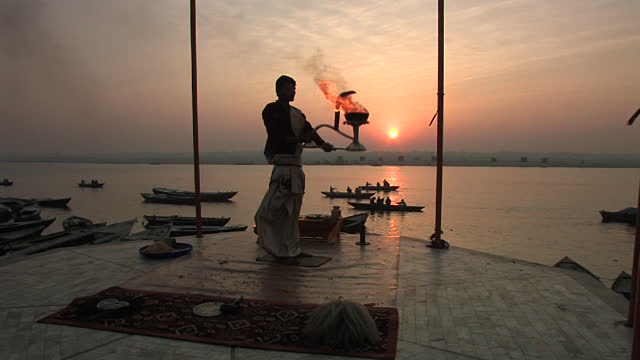
One morning while I was there I got a chance to get out on a boat onto the river. From there I was able to see the flurry of activity that greets the new day in the Holy City. I looked on as people bathed and washed linen on the steps, vigorously splashing the admittedly filthy water onto their bodies to start the morning spiritually afresh. Sadhus sat in tents above them swinging the paddleboard-like instrument of Shiva, God of creation and preservation, chanting to the beat. And various Holy Men stared unseeingly into the dawn, waist deep in the shallows. I watched with deep curiosity as a man with a giant turban silently broke apples apart and scattered them into the current. In the distance the smoke was rising above the burning Ghats, where new souls were being welcomed into Moshka: escape from the Life-Death cycle of reincarnation.

That evening I found myself talking to a German bloke at a rooftop restaurant overlooking the moonlit vastness of the river. We’d both just been underwhelmed by a touristy sunset ceremony that parodied rituals for touristic purposes and we agreed to go together to search out the main burning Ghat, Manikarnika. Here it was said that higher-caste Hindus could purchase bundles of timber to be cremated atop a pyre in the traditional way, as opposed to using gas.
Negotiating the tiny alleys that typify Varanasi’s carless design, we begun to hear the racket of drums and bells being tolled. Tentatively, we wandered through the entrance and out onto the Ghat.
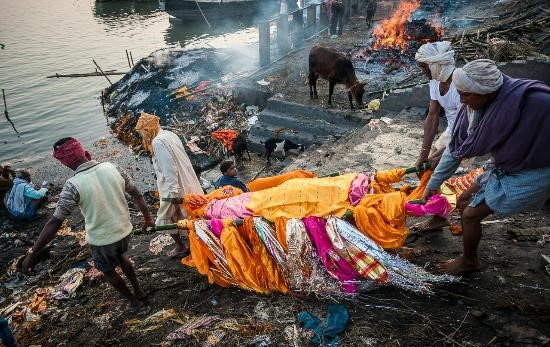
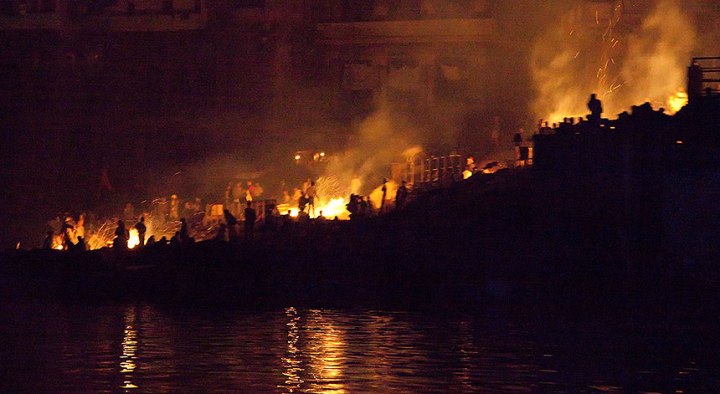
We were standing in an auditorium of steps that sloped down to the waters edge. To our left a gigantic bonfire burned furiously in an open pillared pit and atop a turret an unseen crowd of people tolled bells and chanted mantra. Stacks upon stacks of timber bordered the site. I remember feeling a dark rush of curiosity catching sight of the bodies, adorned as they were with the vibrant pinks and oranges of funeral garb and being carried down to the neat piles of timber. Scattered around the vicinity, other bodies were already burning. Choosing a place that I felt maintained a respectable distance, I stood and watched as the fire was lit on the nearest pyre.
First was the smell.
A powerful stench of burnt hair wafted throughout the complex as the ashes flurried and danced in the breeze. Admittedly, it wasn’t as awful as I’d expected- just foreign – and certainly not of Pork like I’d bizarrely been told before. As the flames licked upward, there was a hissing as they made contact with the deceased. Lower caste men in simple white attire known as ‘Untouchables’ tended the flames as the bodies were consumed, making sure they burned evenly, and even casting flammable powder onto the blaze where needed. Cattle, goats and dogs roamed freely among the ashes, chewing on wreaths of funeral flowers and other things besides. I was later told that this aspect is why the caretaking role of the Untouchables is so important: the bodies barely ever burn in entirety. They are also responsible for casting body parts and ashes into the river for Moshka to take effect.

The hood fell off the deceased’s face which was again, not as horrifying as I’d expected. The heat and cinders lashed against my own face but I barely felt it. As the monotone of the giant bells swelled into a frenzied crescendo, I was totally pensive, meditative. In fact, all around this place of din and death and was a collective sense of something like calm, or release. As I watched the Untouchables tend to the flames, an idea came to me: that of routine.
This was routine for them.
I risked a quick glance at the group of predominantly male family members around me. The flickering red revealed chiseled features of inexpression, not in a callous way, but instead in a way that suggested mourning just hadn’t occurred to them. There was something thrumming in the atmosphere of this place and it wasn’t despair. As far as they were concerned, the deceased had been granted Moshka, release from the ego and neurotic desire. A Dumbledore quote bizarrely came to mind as I took in their faces
“Do not pity the Dead. Pity the living”.
The tolling of the bells abruptly stopped and echoed into nothing. Some moments later only the hissing and spitting of the fires could be heard around the Ghat.
My German friend moved close and I started, snapping out of my trance. I brushed the ash off myself self-consciously and stood to shake his hand. He was leaving. I suddenly realized we’d been there for over an hour but it never occurred to me to leave as well. I couldn’t express it then but something inside me was morphing, even as I watched. In the renewed silence of the Ghat I had become witness to an internal screaming so loud, I could barely draw my attention to anything other than it: the plain realization that I too, would be ash.
I moved slowly around to a slab of marble that overlooked the different pyres. A squatting Indian lad with a square jaw glanced up and welcomed me as I shuffled round behind him. Here I was a little more out of the way of the smoke but still near enough to observe all.
I guess I’ve never really been frightened of death so much as just willfully avoidant of it. A Catholic upbringing ingrained on me the knowledge that because there is an afterlife, then death could be discounted or at least be made more manageable. I suppose this is mirrored in the West by the way we dress death up with elaborate coffins, or with nice clothes and ritual. As I continued to watch the bodies lose their form, it hit me that this attitude might be less than functional, possibly not even aligned with nature itself. And that the consequences of distancing myself from death’s intimate reality could spell trouble for me down the road. That, I think, was the reason I couldn’t look away, not even as the smoke assaulted my eyes and drew tears. For the first time in my life I was truly drinking in the reality that we die. Our lives stop.
And it honestly felt freeing not to hide from it.
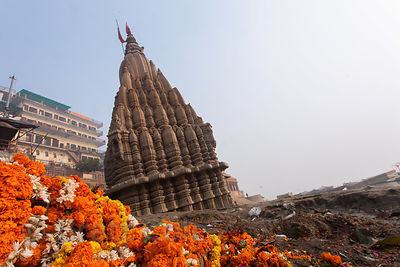
Once more I failed to notice as someone made their way alongside me and I glanced around suddenly. The guy who had welcomed me earlier was gazing into the flames at my shoulder. He looked evenly at me and introduced himself as Ridesh. I told him my name. Despite our similar ages, he spoke to me with the weight of an elder and I guessed at once that he was of the higher Brahmin caste. He’d been brought up here, he told me, as an apprentice on the Ghat. (Brahmins, by the way, are the caste of Hindhus that carry out spiritual practice, give counsel and ultimately make decisions for their communities. Because their trade is symbolic in nature, they often rely on donations from the lower castes). Generally I might’ve expected him to want something monetary. But not with this dude. Ridesh had a purposeful and almost royal way about him that commanded trust. And just like that I managed finally to break through my suspicion I’d let fester since the Delhi experience.
That night we smoked a joint with Ridesh’s circle of friends as the funeral fires burned at our backs. We spoke of the dead and the living; of reincarnation; of our places in the cosmos. And a long-haired friend of Ridesh’s indulgently told me where I could buy DMT.
When in Rome, I suppose!
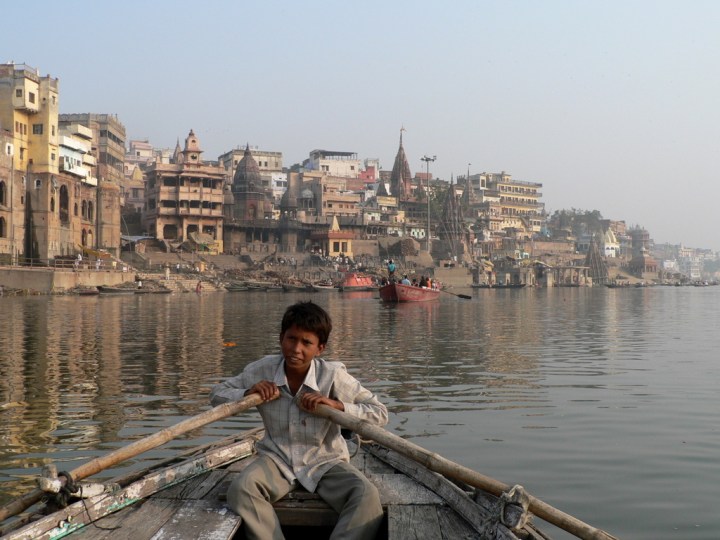
The following day I walked back to the Ghat at Ridesh’s request. To be honest, it was a no brainer. There was nothing else in this iconic but overcrowded city– markets, temples or otherwise – that fascinated me nearly as much as Manikarnika. Standing atop the central turret, we looked on as a group of women surrounded a body who appeared to be the husband of the eldest among them. The latter sobbed, animal-like as she intently went about the rituals with the others, scattering funeral dust and circling the body without pause.
Remembering last night’s becalmed atmosphere, I asked Ridesh about expressing grief on the Ghat who said there was that expectation of minimal expression. He commented that until recently women had not been allowed on the funeral Ghats partly because of the horrific number who would join their loved ones in the flames in so called honor deaths – a problematic statistic in India – Ridesh said, that had to do with Hinduism’s traditional forbidding of remarriage. These days however, there was much more tolerance of female presence. I watched distraught as the widow poured forth her great shuddering grief and her friends looked on abysmally, doing what little they could to console her but ultimately knowing better. As I looked at the deceased older gentleman, my own Grandad was brought to the fore of my mind and the tears came freely as I put myself in their shoes.
Ridesh chided me, but seemed genuinely moved as well. He shared about a loss of his own – his father – as a young boy. He recounted how the earth had come out from under his feet in vicious tremors but that how, with time, he’d come to identify the pain with his ego, his sense of individual self and desire. By allowing himself to fall back on his belief in the oneness of all life he could move onward.His next words have stayed with me to today.
“Why weep for the dead, when I have no idea what it’s like? Why take my eyes of the path and stumble for a reason I’m not even sure of myself?”
That afternoon, we smoked more hashish and planned a dinner across the river with a Sadhu that Ridesh’s guru knew. The guru himself was a real character, striking me as more of a practical joker than a teacher but Ridesh respected him and that was enough for me. Another of his friends was a little larger and slower than the rest but had a peaceful way about him that I liked. After having to tell him to do something twice Guru smiled at me super stoned and just said ‘This is the Animal Planet’ drawing hoots of laughter from the gang as they clapped the large friend on the back, who shot something back in Hindi, a reluctant smile on his face.
By that stage the Ganja had taken its effect and I’d found myself smiling vacantly at the marvelously twirled moustachio of one of Ridesh’s friends as he spoke. I struck me as a wonderful thing. He suddenly grew drunkenly angry with me. I moved quickly to assure him I hadn’t meant offence but Guru just about died with laughter explaining to me that Moustachio was quite simply way too pissed. The accused just accepted it, eyes on the dirt. We became mates later on though, after I supplied the whisky and filled his plastic cup first.
Dinner was to be held on a huge sandbank in the river, across from the old city. Leaving Manikarnika in two row boats we set out toward the distant orange blotch in the darkness that was the tent. As we pulled up onto the silent shore, it became apparent there was nobody home. The evening breeze ruffled the flaps of the entrance and a shiver ran through me.
“Sorry. Ridesh. Who lives here?”
“A holy man. He doesn’t stay in one place but this is one of them. We’ll cook and he will eat too if he arrives”.
Pulling apart the entrance flaps revealed a small, dusty space with a designated fire pit and shrine to Shiva upon which rested hundreds of different totems, busts of Hindu Gods and a single, blackened human skull. I looked questioningly around at Moustachio who by way of answering plainly uttered:
“Black Magic”
As if he were describing that chairs were for sitting.
Ridesh later clarified that some Sadhus performed spells and rituals for people that required certain services such as for personal prosperity or in rare cases for something to be done to an enemy. In general though, he said, the long-haired Sadhus were travelling men of faith who perform many of the same functions as Monks do in the east of Asia. Much later in Nepal I would see the intersection of the two faiths where holy men of Buddhism and Hinduism alike would pilgrimage in their hundreds to the abode of the Gods – the Himalayas being of huge spiritual significance to both traditions.

The food was great.
We feasted on a huge Dal Baht of lentil curry, rice, salad in lime and salt, and balls of bread which we roasted by burying them in the ash of the fire. As hungry night eyes watched from the tent’s entrance, we dined from plates of dried out leaves, eating by hand in the regular fashion. This resident gringo wasted no time in applying hand sanitizer and sheepishly offering it around drawing hysterical laughter and rapid Hindi.
“What the fuck is that?” I believe, was the general sentiment.
A few more whiskies into the evening, a contented quiet grew over us. I excused myself and walked out into the starry night. As I left, the entrance flaps flew in a fresh gust of wind and I shuddered again. Not with cold. But with a vague sensation of being in a storybook scene. As I relieved myself I gazed across the River Ganges at the blazing inferno that was the burning Ghat. Bodies of the faithful continued to be brought down onto the funeral pyres in ceremonial garb. The primordial drive of the drums sounded clearly across the water, accompanied by the chanting and acapella singing of hymns, welcoming the departed souls into Moshka. I plonked down on the sand with my whisky and closed my eyes, letting out a long breath as I did. I continued to see the giant, ceremonial fire (from which all pyres were lit) impressed on the backs of my eyes, silhouetted as it was against the castle-like Ghat.
Much later Ridesh rowed me across the river as I was catching an onward train early that morning. He asked me to hold the oars while he lit a cigarette and then proceeded to row and smoke with only his mouth. I took one look at his proudly grinning face and we both cracked up into the night. Throughout the evening Ridesh had impressed me as the clear leader of his circle. He made fun of people with unmatched authority, explained things to me patiently in his unmatched English, and at times upheld the proud tradition of his heritage by giving a sermon to his awkwardly solemn friends in a manner that was beyond his years.
I was the second passenger he had escorted across that evening.
Unbeknownst to me, one of the group had lost a sick sibling during the course of the night and had quietly left to be with his family. When Ridesh told me, I was hit with a wave of shock and despair but was conflicted to find that the unthinkably tragic news somehow wound into my experience in Varanasi without much incongruence. I thought about what Ridesh had told me about his own pain and the humbling lessons this place had given me. A place where enormous, tragic loss of life, both young and old, somehow mixes with the most beautiful aspects of raw human ritual and nature; where cruel but blissful reality is soberly acknowledged in it’s nakedness; where the age-old questions of life and death are answered simply: ‘they are’.
After spending that time with Ridesh and his circle, I felt no longer to be among the hordes of package tourists in India.
It even felt good when I missed my train! Fuck the system!
The only train we really catch is Moshka. And how we learn to stand, unbent on the platform affects the eventual journey we all make.
Including blowing a thousand dollars on a trip every now and then!
 jared lanigan