
If you put shame in a petri dish, it needs three ingredients to grow exponentially: secrecy, silence, and judgment. If you put the same amount of shame in the petri dish and douse it with empathy, it can’t survive.
Brenè Brown
In my experience, the single most common phrase out of the mouth of someone who is struggling is “I don’t want to be a burden”
Depression has the strike rate it does because it attacks the motivation to do the things that tie us to life. Self care, touch, creativity, movement but easily the biggest factor is connection. It amps up the volume on our shame, makes a mockery of our worthiness to reach out and replays in HD all the times we needed help and someone we love dropped the ball.
“If you just got up sooner and went for a run…”
“You have so much to live for!”
“At least you’re still passing”

Can this kind of sympathy be helpful? Maybe once the person feels heard (i.e. not judged) but hardly ever when someone is in the throes of their emotive storm. It might sound bizarre but when someone we know is really upset the best thing we can do is actively and curiously listen to their pain as they express it. Consider how you would feel hearing the following:
“It sounds like you just wish he’d be more present…”
“Mhmm”
“Anyone in your position would have the right to a bit of sadness there, I think”
“You mentioned ______. Can you tell me a bit more about that?”
This is not to judge people who use sympathy as it certainly has its place, especially in smaller matters. Our tendencies to fix, relate someone’s story to ours or make a judgement on how good or bad their situation is are all deeply human things to do. As kiwis, we want to be resourceful, to help one another and ease the other’s pain. This is human. The only risk we run by taking this approach with larger pain is that we subtley say to the person: “If you just did X, Y and Z like me, you would be fine”. While pragmatic, this sentiment is likely to add to rather than reduce the shame someone might hold about feeling so stuck.

Imagine, for instance, that it is you in the hot seat. You’ve had a fight with a long time friend. Your brain has been playing on repeat what was said and all the various ways you could have avoided the conversation or done things differently. You approach your partner in desparation to get out of your own head and vent some of what is going on. Your partner hates seeing you hurt and confused. In fact, it makes them worried as well so at the first break in the traffic of your story, they suggest one of the things that has already occurred to you a hundred times:
“Well, maybe next time just tell them how you’re feeling”
How might this situation have played out differently if your partner had mirrorred back to you the feelings and needs you were communicating to them:
“Honesty is really important to you aye?”
“You’re pissed off with them”
“I can’t imagine what that must feel like”
“I’m hearing you wish the whole exchange just never took place”

In other words, the primary job of the listener is to facilitate the person’s self-exploration and piecing together of their own puzzle. This is an amazing frame to adopt, not just because it takes the pressure off us to have “the answer” but also when someone is genuinely upset, they are often not in a logical mindset, seeking rational ways out. They are highly emotionally charged and the child within them is wrestling with some pretty serious threats to their core needs. A child which might require soothing before any problem solving is looked at.
Another way of breaking this down is by considering the two very different parts of the brain repsonsible for logic and emotion. American Psychologist Johnathan Haidt provides us with a suitable metaphor of a rider atop an elephant. The elephant in this case represents our vast emotional response to a threat originating in the older, reptilian part of the brain that sends immediate messages about what to do to survive. The rider represents the ego or executive control, the pre frontal cortex responsible for rational decision making and weighing of evidence which in the West, we make the heinous assumption should be in control of the elephant.
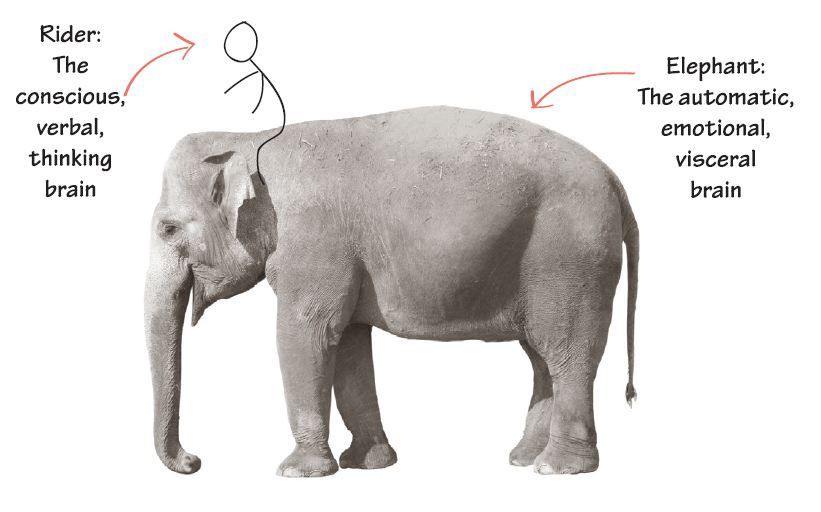
Whether in a heightened facebook comments section or attempting to hear out the distress of someone you love, we do both parties a major service by acknowledging the feelings and points of view of the speaker (i.e. the elephant in the room) before we move into engaging with our perspective. People are simply more likely to respond with reason to reason when their emotional needs to be heard, valued and understood have first been addressed. And this doesn’t have to involve 100% agreeing with a bleak perspective either. For instance, I like to include both an acknowledgment of what is both good and difficult (in that order) when I offer a reflection.
“Ok so even though a deeper part of you knows you are loved, what you’re saying is that it’s nearly impossible to feel it when you are so stressed out with work?”
This ensures the person’s view is held sacred while we chip away lovingly at their belief that all hope is lost.
Sometimes the content is so heavy or the feelings have become so dark, we will literally not know what to say. Brene Brown suggests we start by owning just that:
“I don’t even know what to say right now, I’m just so glad that you told me”
Because truly difficult situations are rarely solved by someone saying the right thing at the right time. So take the pressure off yourself to be that hero. What does help when the chips are down is someone warmly and curiously beholding the contents of our heart.
Once the speaker has had a chance to vent, the odds are very good that by sitting in silence, reflecting what we’re hearing and asking curious questions (“Can you tell me a bit more about…?”), they are going to come to some of their answers of their own accord. And you know what else? These are going to be the solutions that stick for them!

Now, am I saying all advice giving is unhelpful? Far from it!
Many, many times our loved one is not going to be seeing the problem from the slightly detached, more objective lens we’ve got and there may be an opportunity to ask for permission to share what you are seeing. Think of it as two rock climbers struggling on their own wall, but with slightly different persepctives on the path the other is taking, and offering each other clues as they go. For instance, you might spy a pause in the flow of conversation or a sigh accompanied by a “I just don’t know what to do”. Let’s call it a “turning point”. It’s here where we might offer some of the wisdom from our heart but it’s best to once more acknowledge the feelings and then request permission to share:
“Gosh, I can see why this has been keeping you up. It sounds so tough not knowing where you stand with her…can I offer one thought I had as you were speaking?”
“…uh…sure!”
“I’m wondering if she might be wondering the same thing about you?”
I can say that the vast majority of people – even perfect strangers! – are very pleasantly surprised to be asked for their permission in this way and quite apart from engaging their ego defenses, we instead come up against an open heart curiously awaiting our point of view.

With our plates so full in today’s world, to sit and hold someone else’s emotional state with the full and compassionate gaze of our mind’s eye can be a big ask. But if we can hold off on the immediate compulsion to fix, share how we relate, or interpret what’s “really going on”, we provide the most scientifically-proven form of care:
Our loving and curious acknowledgment of their inner world.
Start there, then if they don’t come to it on their own, ask them what they think they might need going forward:
“What do you think you need right now?”
“Given everything that we’ve been talking about, what do you think needs to happen for you today?”
They might not know! Smiling, we ask:
“Can I make another suggestion?”
“Yeah?”
“I think today is about you giving yourself some time and I think work can wait. Can we call your boss?”
“Okay”
“Okay”
 jared lanigan